


Something bizarre happened to the election data coming out of Texas.
Multiple credible reports of data irregularities that are stumping election observers.
And now, in the aftermath of the November 3 midterm elections, Texans are wondering if the “blue wave” was a tsunami or a mirage.
Start with the governor’s race. Democrat Gina Hinojosa reportedly received approximately 5.23 million votes in her race against Republican Gov. Greg Abbott.
That would be an unbelievably high number.
For comparison, Abbott received approximately 4.66 million votes in 2018 and 4.44 million in 2022. His reported 2026 total was around 4.5 million.
His numbers barely moved. But the Democratic numbers apparently exploded.
This is reminiscent of the Biden election in 2020. Trump got 74 million votes but Biden got “82 million votes.”
While running a no-show campaign. Apparently, just because Orange Man Bad.
Well, the difference here is that Trump wasn’t on the ballot.
We can debate whether or not Paxton was the right choice, I feel like his deficits were overblown because he was running against a well-documented blasphemer with crazy radical views.
But when you see Paxton’s loss in the context of the overall Texas results, it doesn’t make a lot of sense.
Nonetheless, Talarico was only up a few points on Paxton heading into Election Day, but he will wind up beating him by… 10 points? And Hinojosa is apparently going to win by 7 points.
Let’s put this in context. In 2018, Democrat Lupe Valdez received approximately 3.55 million votes. In 2022, Beto O’Rourke received approximately 3.55 million.
Now Hinojosa is reportedly sitting at 5.23 million.
That’s an increase of roughly 1.68 million Democratic votes over the previous gubernatorial election.
And it gets even more interesting.
Democrat James Talarico reportedly received approximately 5.45 million votes in the U.S. Senate race, a figure approaching Donald Trump’s entire Texas presidential vote total in 2024.
The question is obvious: What explains that enormous increase?
A surge in Democratic turnout is certainly possible. But the scale of the reported change makes the underlying county-by-county numbers worth examining, particularly given the questions already surrounding Texas election reporting.
And those questions began before Election Day. On November 1, the independent research publication This Will Hold published an investigation titled “Texas Turnout Totals Are Moving Backwards. We Want To Know Why.”
Its researchers had been preserving successive snapshots of the Texas Secretary of State’s early-voting dashboard.
What they reported was remarkable.
A previously published October 19 early-voting total reportedly fell from 806,239 to 777,891 between snapshots captured on October 22 and October 23.
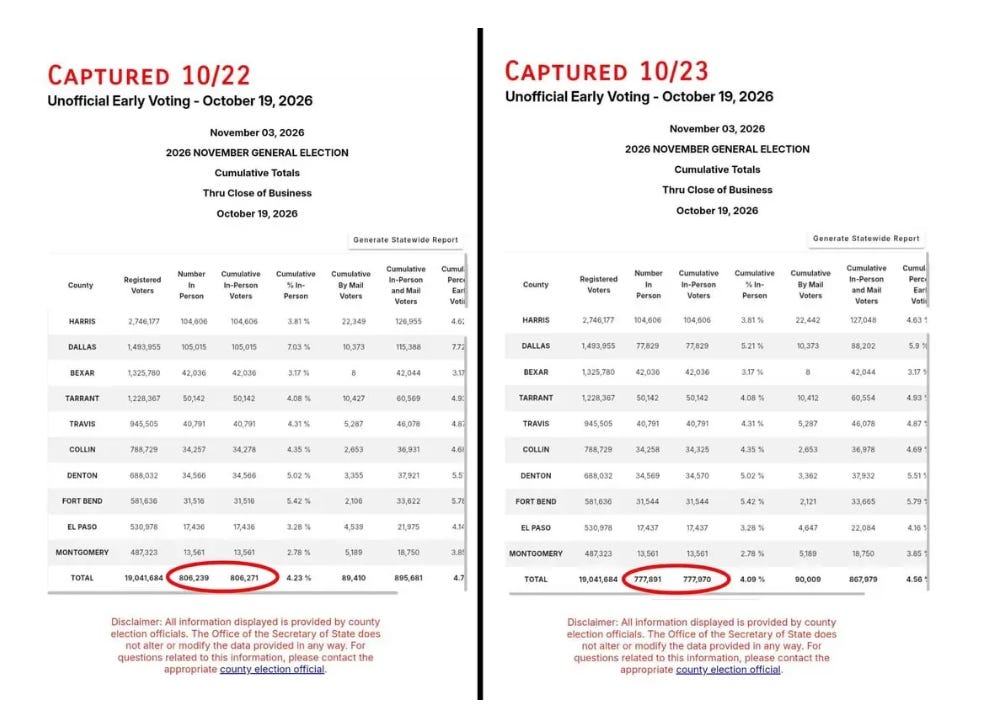
That’s a decrease of 28,348 in the published figure for the same voting date.
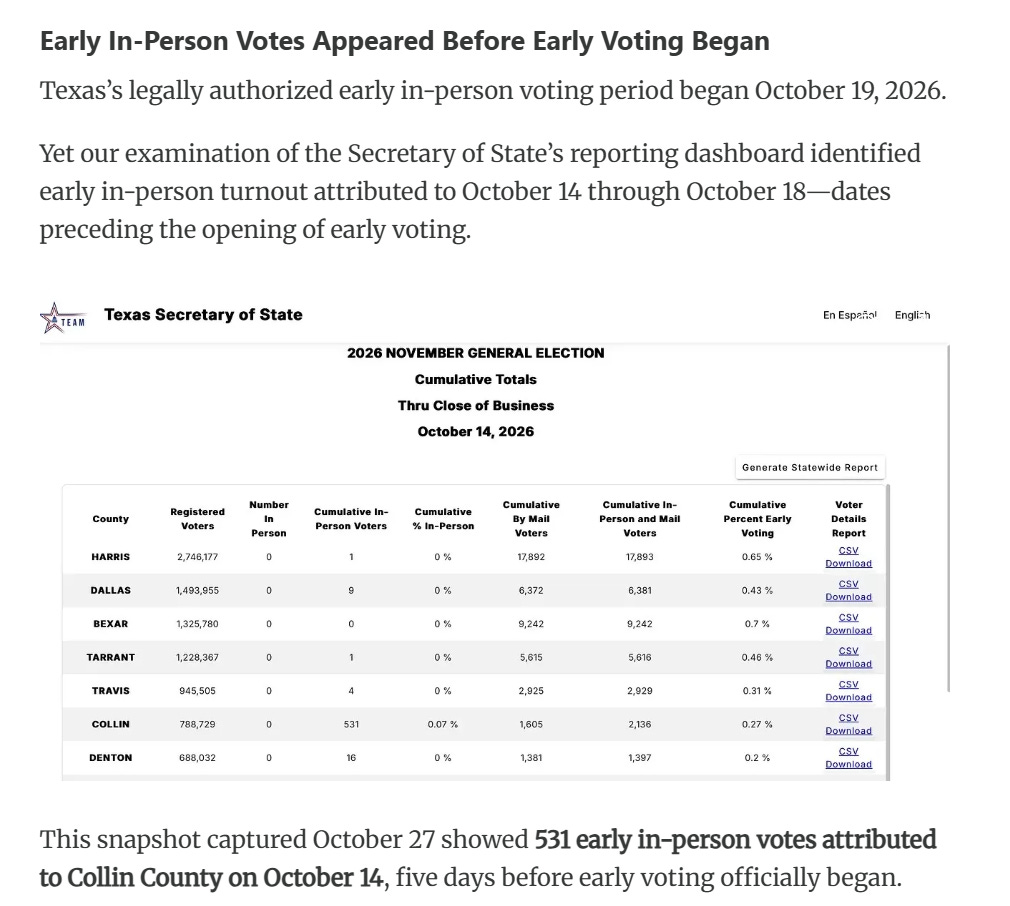
The investigation also documented a reported 1,224-ballot decline in a previously published mail-ballot total, early in-person votes attributed to dates before early voting officially began, and a 27,049-vote discrepancy between Harris County’s reported October 28 turnout and the corresponding state dashboard figure.
Collin County is my county. I recall seeing a page posted on the early voting and the Election Day voting tabulating how many voters had showed up to vote for various time periods in the day.
Election Day, for example, had at least 330 voters before 11:30 am. Their logs might be able to help ascertain the discrepancies.
Perhaps most strikingly, the researchers identified historical daily and cumulative turnout figures that could not be reconciled through straightforward arithmetic without accounting for intervening revisions.
One comparison produced a disparity exceeding 310,000.
These were discrepancies in published turnout reports, not established findings that ballots had “disappeared.: But they were substantial enough to demand an explanation.
This isn’t solely coming from a “blogger.”
The Houston Chronicle reported discrepancies between state and county early-voting figures, including substantial differences involving Bexar and Fort Bend counties.
Spectrum News also documented reporting problems involving Texas’ newer Election Administration Management system, known as TEAM.
Meanwhile, Votebeat reported on difficulties county officials encountered with the TEAM system, including problems with its functionality and the processing of voter-registration records.
The Texas Tribune separately reported on a substantial voter-registration backlog that officials worked to clear before early voting.
Those documented system problems provide a plausible explanation for at least some of the early-voting discrepancies.
But a general explanation about computer glitches is not the same thing as an itemized accounting of what happened.
The state should be able to identify which figures were revised, when the revisions occurred, which counties submitted them, and how the final numbers reconcile with the underlying election records.
Now the unusually large Democratic vote totals are raising a separate set of questions.
How much of the increase came from higher turnout in traditionally Democratic counties? How much came from suburban shifts, new voters, or changes in voting behavior? Did Republican candidates receive a comparable increase in votes in any major counties? And do the reported statewide totals reconcile with the official county canvasses?
Here’s something problematic. In North Texas, Republican Brandon Gill defied the odds and was able to win re-election in District 26, yet Talarico won there by 13 points.
How? And what could that election tell us about the other contests, where there was an unmitigated “blue wave” that washed over nearly every single district.
Those are questions that can be answered with records available through the Texas Elections Division.
The raw totals cited on social media still need to be checked against official results, and unusually high turnout is not, by itself, evidence of manipulated votes. The early-voting dashboard discrepancies and the reported election outcomes also should not be assumed to have the same cause.
But the broader demand for transparency is entirely reasonable. Texas voters deserve a clear, independently verifiable accounting of the numbers.
Because when public election reports change by tens of thousands of votes, and in some comparisons hundreds of thousands, officials should be able to show exactly what changed and why.
And when one party’s reported vote totals surge by more than a million while the other party’s remain relatively stable, the public should be able to examine the precinct- and county-level data that explain the difference.
Then show the records.
America’s election officials must be treated like the former Soviet Union: “Trust, but verify.”
Check out “Hypernea: The Cursed Kingdom.” It’s a fantasy novel for all audiences that has drawn rave reviews and a 4.6/5.0 rating on Amazon!
You may be onto something. I read this last night. I find it easy to believe the Dems and their color revolution silent team would do a county by county analysis, even drilling down to precincts, neighborhoods, streets to calculate just how much they have to peel off or peel on the right votes, presumably by some fraudulent means. If they can steal Texas, if we can't overcome all the leftists who moved from blue places plus fraud, 2028 is the end.
https://substack.com/@justindeschamps/note/c-378548592?r=fjnqx
So, what is John Thune doing about this ?