


There is a political prisoner in America. What was once considered to be unthinkable in the Land of the Free and the Home of the Brave is now the grim reality in our country.
You may not have read about her in the news. If you did, you might have dismissed her case as too difficult-to-understand. You might have bought the line that the 2020 election was the “most secure election in history.”
But make no mistake — the suspect and contested 2020 election led to a political prisoner, who is now languishing in “hellish” conditions in a Colorado prison.
And if the reports of fellow inmates beating this Gold Star mother, who is afflicted with cancer, are true — the system may be trying to silence her for good.
What is being done to Tina Peters is not just a travesty — it is a warning from a corrupt system that punishes whistleblowers and protects itself at all costs.

Her imprisonment is not merely the story of one woman; it is the story of a national election apparatus so frustratingly opaque, so needlessly complex, and so politically weaponized that the mere act of questioning it has become a criminal offense.
America’s elections have grown so complicated, so dependent on proprietary software, and so resistant to independent audit that ordinary citizens can no longer verify how their votes are processed.
And when a system becomes impossible to understand, it also becomes impossible to challenge. That is why Tina Peters is in a concrete box while the corporations behind the machines — and the state officials who deploy them — face no scrutiny at all.
The structure of our elections has shifted from transparent civic process to protected industrial product, enforced by courts rather than accountable to the public.
And in that new regime, whistleblowers are not only inconvenient — they are dangerous.
Peters’ real offense was not “criminal impersonation” or “official misconduct.” Her real offense was violating an unwritten rule: you are never allowed to expose the inner workings of the election system if what you find damages the narrative of the ruling class.
That is why she received a nine-year sentence harsher than many violent felons. The state needed to make an example of her. And the contrast with those on the other side of the political equation could not be clearer.
When Ruby Freeman and Wandrea “Shaye” Moss were accused — rightly or wrongly — of election irregularities, the entire Democratic political machine mobilized in their defense. They were shielded, praised, financially supported, and legally protected.
No dawn raids. No criminal indictments. No solitary confinement. No judge berating them from the bench. Their claims were treated as gospel, their testimony as sacred, and any criticism of them as an act of violence.
Yet when Tina Peters raised alarms — using her lawful authority as a county clerk — the machinery of the state crushed her without hesitation.
A federal judge on Monday decided not to release former Colorado clerk Tina Peters from prison. Peters is the only Trump ally currently incarcerated for crimes connected to efforts to overturn the 2020 election.

Last year, a state jury found Peters, the former Republican clerk for Mesa County, guilty of taking part in a scheme with other election deniers to access the county’s protected voting equipment. They hoped this would help validate Trump’s false claims of widespread fraud.
Trump has continued to support Peters, 70, who is now a year into a nine-year sentence, referring to her as an “innocent political prisoner.” Trump is facing strong pressure to get more involved in pushing for her release, and she has reportedly applied for a presidential pardon.
Earlier this year, Peters filed a federal habeas petition, arguing that her conviction raised constitutional problems, especially regarding her free speech rights. But US Magistrate Judge Scott Varholak turned down her request.
Varholak said he couldn’t grant her immediate release because the timing and jurisdiction weren’t appropriate for the challenge. He wrote that “Ms. Peters raises important constitutional questions concerning whether the trial court improperly punished her more severely because of her protected First Amendment speech.” But since “this question remains pending before Colorado courts,” he said the federal court must wait “until after the Colorado courts have decided the issue.”
This is a two-tiered justice system, and everyone sees it. One tier rewards those whose narrative props up the establishment. The other tier destroys those whose evidence threatens it.
And this is precisely why faith in elections has collapsed: not because of online “misinformation,” but because Americans can see with their own eyes that whistleblowers are punished, not heard; that audits lead to prosecution, not transparency; and that government agencies and private vendors hide their processes behind “intellectual property” shields that prevent even elected officials from examining the systems they are legally responsible for overseeing.
If the public cannot check the system, and the officials inside the system are jailed for trying, then who exactly is safeguarding democracy?
Tina Peters’ suffering — the reported solitary confinement, the lung cancer, the retaliation for contacting the White House, the beatings from fellow prisoners, the silence from Colorado officials — is not an oversight from a callous system.
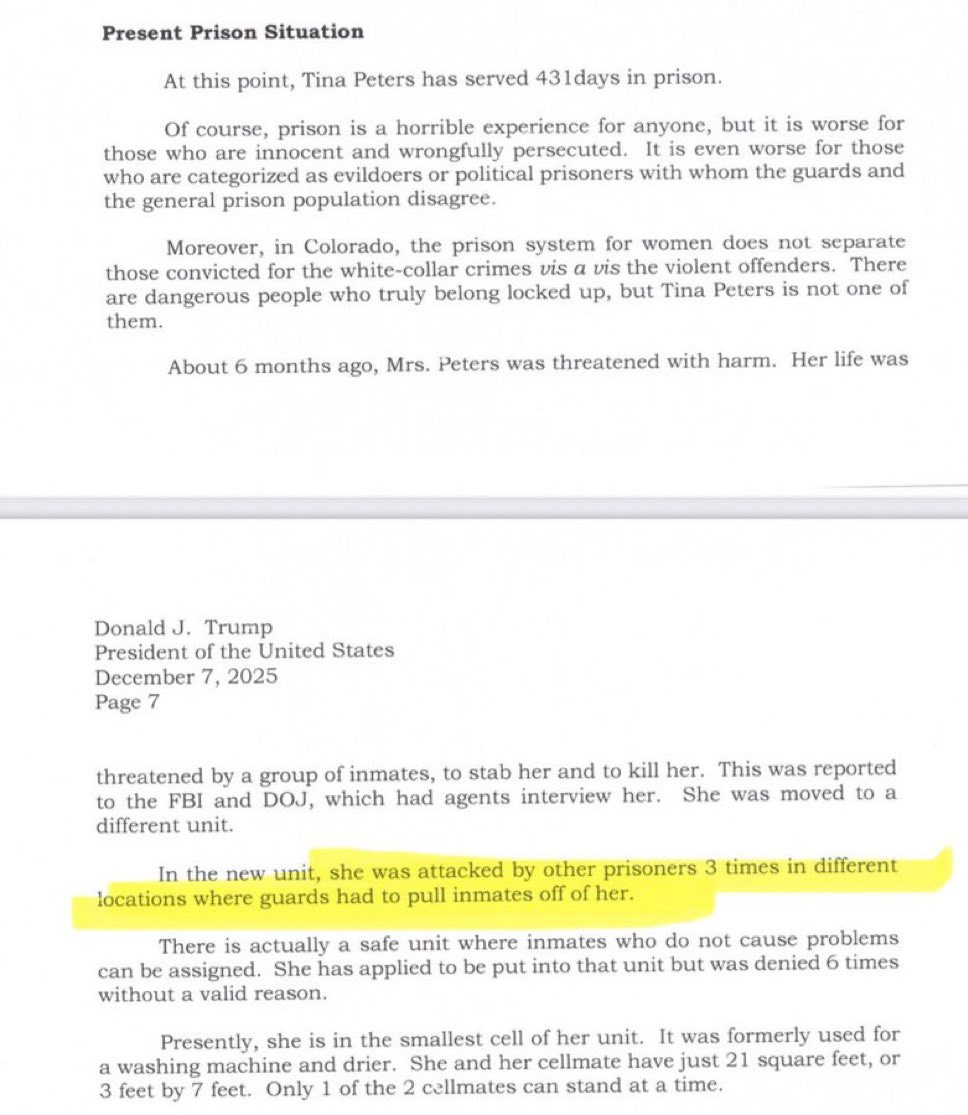
It is the brutal enforcement mechanism of a corrupt machine. Her cell is not only a punishment; it is a signal: challenge the process, question the machines, or expose the vulnerabilities, and the state will bury you.
This is why her case matters. This is why the DOJ investigation matters. This is why election transparency matters. Because the moment a republic must cage whistleblowers to preserve confidence in its elections, it has already admitted the system cannot withstand scrutiny.
And that is the indictment — not of Tina Peters, but of the system itself.
This week, Assistant Attorney General Harmeet K. Dhillon, head of the DOJ’s Civil Rights Division, announced a formal federal investigation into the Colorado Department of Corrections, explicitly citing the treatment of Tina Peters as one of the triggering concerns. For the first time, the federal government acknowledged that conditions inside Colorado’s prisons — including solitary confinement, medical neglect, and retaliatory isolation — demand scrutiny.
Dhillon stated:
“The Constitution protects every American, whether they are a young person confined in a juvenile facility or an elderly person confined to a prison. We are committed to upholding our federal civil rights laws so that no one is subject to unconstitutional mistreatment when held in state custody.”
How did we get her? In the hysteria following the 2020 election contest, Colorado Secretary of State Jena Griswold became a national MSNBC fixture, warning of “election deniers” everywhere except in her own office — where transparency was treated not as a civic duty but as a threat to the regime.
When Peters discovered that Colorado’s “Trusted Build” update would erase election records — records federal law requires clerks to preserve — she did what every whistleblower is instructed to do: she documented everything. She preserved evidence. She sought oversight. She asked questions.
In a functional democracy, that is exactly what we want officials to do. In Colorado, it got her nine years in prison.
And that brings us to the heart of the problem — the thing no one in the corporate press or the political class wants to acknowledge:
A healthy election system does not need secrecy.
A legitimate election system does not fear audits.
A trustworthy election system does not imprison whistleblowers.
If the system worked, documenting it wouldn’t be a crime.
If the machines were reliable, copying their hard drives wouldn’t be dangerous.
If the data told a clean story, no one would panic about preserving it.
Instead, election technology in America is treated like the nuclear codes — withheld from public scrutiny, locked behind “proprietary software” claims, and guarded by the very officials whose political fortunes depend on the system remaining unquestioned.
This is backwards. In a self-governing republic, the people — not private vendors — own the election process. Election systems should be simple, transparent, and auditable by ordinary citizens.
Instead, we have built a labyrinth so complex that only machine vendors and a handful of consultants understand it — and they refuse to share the details.
This complexity does not inspire confidence; it annihilates it.
Which is why election reform must start with three simple principles:
1. Photo voter ID — applied universally.
We require ID to buy Sudafed, enter a federal building, or pick up a package.
We can require it to choose a president.
2. All-paper ballots, counted by hand or with auditable scanners.
Every vote should have a physical record.
No exceptions, no disappearing data, no machine purge cycles.
3. One Election Day — with limited exceptions.
Months-long voting windows erode chain of custody, weaken public trust, and create endless opportunities for mismanagement.
Anything less, and we are inviting doubt into the foundation of democracy.
But Tina Peters is the real-world consequence of ignoring these principles. She is the human embodiment of a system that reacts with hostility when its inner workings are questioned. Her imprisonment sends a message far beyond Colorado: do not examine the machines, do not save the data, do not challenge the assumptions, and do not break ranks.
And yet, her treatment does something else too — something Colorado officials did not intend:
It exposes the fragility of the very system they claim is unassailable.
If an election process collapses the moment someone audits it, it is not secure.
If transparency threatens it, it is not trustworthy.
If whistleblowers must be crushed, the problem is not the whistleblower — it is the system.
Tina Peters’ cell is not just a punishment; it is a confession.
A confession that the election apparatus in this country is so vulnerable, so opaque, and so politically infected that even routine oversight must be criminalized to protect it.
And that is why her case matters — not just to her supporters, not just to Colorado, but to the entire country. Because if we allow this precedent to stand, then every future election clerk, every concerned citizen, every auditor, and every whistleblower will learn the same lesson Tina Peters is being taught right now:
Ask questions — go to prison.
Preserve evidence — lose your freedom.
Protect election records — die in solitary confinement.
DOJ’s stall tactic that just delays justice and seeks information already know -ALL BULLSHIT, our DOJ is a criminal organization
Thank you. Great article! Praying for Tina.